Integrated MS+PGP Program in Data Science & AI

Elevate your career with dual, industry-recognized certifications in Artificial Intelligence

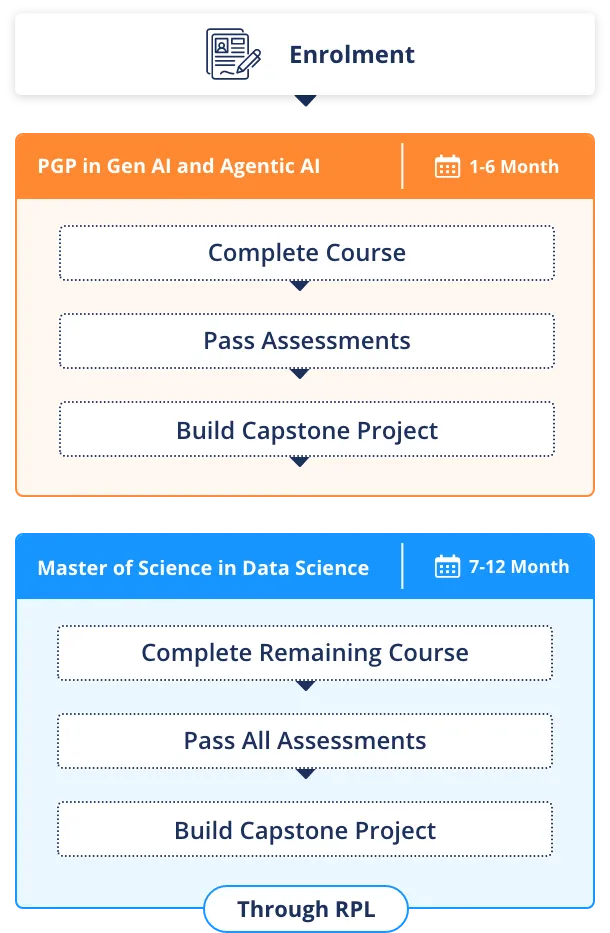
  • Earn dual certifications within 12 months instead of standard 24 months 
  • Fast track your learning through RPL (Recognition of Prior Learning  
  • Dual Certification Phase 1: Earn PGP in Generative AI and Agentic AI  in 6 months
  • Dual Certification Phase 2: Accelerated MS in Data Science from Birchwood University 
  • Learn through a perfect blend of live online and asynchronous learning modules
  • Work on real-world AI projects and build a strong industry-ready portfolio
  • Get both programs at a special combo price with our Learn More, Pay Less initiative
2169 Learners 4.9 102 Ratings

Earn two career-defining certifications within 12 months through our RPL enabled learning pathway. Begin with a 6-month PGP in Generative AI and Agentic AI, then progress to an accelerated MS in Data Science from Birchwood University. Learn through live and self-paced modules, work on real projects, and join us now to get a special combo price.

Integrated MS + PGP Program Highlights

...

Gain advanced expertise in Generative AI, Agentic AI, and Data Science to tackle real-world business challenges.

...

Build a strong professional portfolio through capstone projects and applied AI solutions.

...

Open doors to AI, ML, and Data Science roles across industries and geographies, backed by dual university credentials.

Integrated MS + PGP in Data Science & AI Learning Track

... ...

Market Opportunities

$279 B

MARKET SIZE
...

Global artificial intelligence market projected to grow from about US$279 billion in 2024 to roughly US$3.5 trillion by 2033

- Grand View Research

34%

Job Growth
...

Data science jobs in the U.S. are expected to grow 34% by 2034, outpacing the other job roles

- Bureau of Labor Statistics

$181 K

Average Salary
...

Average base salary for AI Engineers in the US is around US$181,000 per year in 2025

- builtin.com

PHASE 1 PROGRAM STRUCTURE

Post Graduate Program in Generative AI and Agentic AI

  • Module 1: Python Programming Essentials
  • Module 2: Advanced Data Structures, Asynchronous Patterns, and Logging
  • Module 3: Numerical Computing and Data Analysis with NumPy and Pandas
  • Module 4: Data Visualization with Matplotlib and Seaborn
  • Module 5: Building AI APIs and Backends with FastAPI
  • Module 6: Building AI Native Applications with Streamlit and Gradio
  • Module 7: AI Pair Programming Fundamentals with GitHub Copilot

  • Module 1: Generative AI and LLM Foundations
  • Module 2: Transformer Architectures and How LLMs Work
  • Module 3: Working with LLMs: APIs, SDKs, Parameters and Open-Source Models
  • Module 4: Prompt Engineering Essentials
  • Module 5: Advanced Prompting Techniques
  • Module 6: Context Engineering: Memory, Windowing and Retrieval
  • Module 7: Structured Outputs, Function Calling and Tool Use
  • Module 8: Prompt Optimization, Evaluation and DSPy

  • Module 1: Embeddings and Semantic Search
  • Module 2: Working with Vector Databases
  • Module 3: Developing RAG Systems
  • Module 4: Advanced RAG: Hybrid Retrieval, Re-ranking and Agentic RAG
  • Module 5: Building LLM Apps with LangChain and LlamaIndex
  • Module 6: Multimodal LLMs and Beyond
  • Module 7: Building and Deploying End-to-End GenAI Applications
  • Module 8: Securing LLM Applications: Guardrails, Safety and Prompt Injection Defense
  • Module 9: Evaluating GenAI Applications
  • Module 10: Fine-Tuning and PEFT

  • Module 1: Agentic AI Foundations and Agent Architectures
  • Module 2: LangChain Core — Chains, Memory and RAG
  • Module 3: LangChain Agents and Tool Use
  • Module 4: LangGraph — Stateful Workflows and Routing
  • Module 5: LangGraph — Cycles, Human-in-the-Loop and Persistence
  • Module 6: Multi-Agent Orchestration with CrewAI
  • Module 7: Multi-Agent Systems with Microsoft AutoGen
  • Module 8: Agentic RAG and GraphRAG for Agents
  • Module 9: Deep Agents — Reflection, Planning and Long-Term Memory

  • Module 1: Model Context Protocol — Architecture and Custom Servers
  • Module 2: MCP Ecosystem Integrations
  • Module 3: Agent Interoperability — A2A Protocol 
  • Module 4: Agent Interoperability — ACP and ANP
  • Module 5: Evaluation and Tracing with LangSmith
  • Module 6: AI Guardrails and Safety — NeMo and Guardrails AI
  • Module 7: Fine-Tuning and Agent Performance Optimization
  • Module 8: Dockerizing and Deploying AI Agents

  • Module 1: Agentic Workflows with n8n
  • Module 2: Workflow Automation with Zapier
  • Module 3: Building with Make
  • Module 4: No-Code Agentic AI with Flowise

  • Module 1: Foundations of MLOps and LLMOps
  • Module 2: LLM Infrastructure, Tooling and the Open-Source Stack
  • Module 3: Deployment, Containerization and Scaling of LLM Systems
  • Module 4: Monitoring, Governance and Responsible AI in Production

  • Design, create and deploy end-to-end agentic AI applications

  • Module 1: Vibe Coding Fundamentals and AI Driven Development
  • Module 2: AI-Powered Development with Cursor AI
  • Module 3: AI-Native Software Development with Google Antigravity
  • Module 4: Accelerating Development with Amazon Q Developer

  • Module 1: NLP Foundations and Text Processing
  • Module 2: Feature Engineering and Text Representation
  • Module 3: Tokenization, Embeddings and Text Encoding
  • Module 4: Sentiment Analysis and Text Classification
  • Module 5: Neural Language Models and Sequence Modelling
  • Module 6: Transformers and the Path to Large Language Models

  • Module 1: Introduction to Claude and the Anthropic Model Family
  • Module 2: The Anthropic API — Messages, System Prompts and Tool Use
  • Module 3: Claude Code and Agentic Development with Claude
  • Module4: Claude with MCP

PHASE 2 PROGRAM STRUCTURE

MS in Data Science by Birchwood

Gain insight into the Python Programming language with this introductory course. An essential programming language for data analysis, Python, Programming is a fundamental key to becoming a successful Data Science professional. In this course, you will learn how to write python code, learn about Python's data structures, and create your functions. After the completion of this course, you can represent yourself as an ideal candidate for python Developer.

In this course, students will learn how to manage the Data Effectively using My SQL Work Bench. Students will come to know how to Apply Certain Joins techniques, how to manipulate the data. Will be able comfortably design SQL queries to add data to the database, will be familiar with editing, deleting data from the database, and will be able to describe and develop Relational Algebra and Relational Calculus queries.

Gain insight into the R Programming language with this introductory course. An essential programming language for data analysis, R Programming is a fundamental key to becoming a successful Data Science professional. This course will teach you how to write R code, learn about R's data structures, and create your functions. After the completion of this course, you will be fully able to begin your first data analysis.

This course includes the necessary exploratory techniques for summarizing data. These techniques are typically implemented before formal modeling begins and can help in informing the development of numerous complex statistical models. Exploratory techniques are also essential for eliminating or sharpening potential hypotheses about the world that the data can address. In this course, we will study plotting systems and the basic principles of constructing data graphics. We will also cover some of the standard multivariate statistical techniques used to visualize high-dimensional data.

Machine Learning course will make you an expert in Machine Learning, a form of Artificial Intelligence that automates data analysis to enable computers to learn and adapt through experience to do specific tasks without explicit programming. You will master Machine Learning concepts and techniques, including supervised and unsupervised learning, mathematical and heuristic aspects, and hands-on modeling to develop algorithms and prepare you for your role with advanced Machine Learning knowledge.

Implementing models such as support vector machines, kernel SVM, Naive Bayes, decision tree classifier, random forest classifier, logistic regression, K-means clustering, and more in Flask, sending and receiving the requests from deployed machine learning models, building machine learning model APls, and deploy models into the cloud, design testable, version-controlled, and duplicate production code for model deployment.

The Artificial Intelligence course will expand your technical function and become an expert in Artificial Intelligence that automates data analysis to enable computers to learn and adapt through experience to do specific tasks without explicit programming. You will master Al concepts and techniques, including, Deep Learning, mathematical and heuristic aspects, and hands-on modeling to develop algorithms and prepare you for your role with advanced Al knowledge. Also, it will help in understanding Convolution Neural Networks Convolution, Pooling and Generative Networks Adversarial Networks, and these skills will enable candidates to seek their career in their desired companies.

Data Visualization using Tableau - Tableau Course will help you master the various aspects of the program and gain skills such as building visualization, organizing data, and designing dashboards. You will also learn concepts of statistics, mapping, and data connection. It is an essential asset to those wishing to succeed in Data Science. After learning the tableau tool, one must be able to display and analyze data. Also, it enables the users to create various reports and presentations about data.
Data Visualization using Power Bi - In this course, you will master the various aspects of the program and gain skills such as building visualization, organizing data, and designing dashboards utilizing data visualization using Power Bi. You will also learn concepts of mapping, and data connection; users will be able to provide clear and actionable insights in less than a minute. It also enables the candidate to import data from multiple sources. And learn how to transform the data. It is an essential asset to those wishing to succeed in Data Science.

The capstone project will allow you to implement the skills you learned throughout this program. Through dedicated mentoring sessions, you'll learn how to solve a real-world, industry-aligned Data Science problem, from data processing and model building to reporting your business results and insights. The project is the final step in the learning path and will enable you to showcase your expertise in Data Science to future employers.

Program Fees

Post Graduate Program in Generative AI and Agentic AI
$1,592
MS in Data Science by Birchwood
$11,850
Total Price: $13,442
*Limited Time Offer

Payment Options

The Indian pricing is inclusive of GST for all learners.
The combo price offer is valid only with full upfront payment for a limited period of time.
Finance (EMI) option is available for learners who prefers flexible payment options.

...

Got questions? Request a callback

+1

Thank you! We received your request and will call you shortly

Frequently Asked Questions (FAQs)

  • The Integrated MS + PGP in AI combines two prestigious qualifications, the Master of Science in Data Science by Birchwood University and the Post Graduate Program in Generative AI and Agentic AI by Edureka.

    This accelerated program builds a strong foundation in data science while developing advanced, industry-ready expertise in AI and machine learning. The integrated curriculum offers a complete understanding of the data-driven technologies shaping the future of business and innovation.

    A key differentiator of this dual pathway is the Recognition of Prior Learning (RPL) model, which allows learners to complete the entire program in just 12 months instead of the usual 24, graduating with two recognized credentials.

    By the end of the journey, learners gain hands-on experience across data science, artificial intelligence, and machine learning, empowering them to fast-track their careers and succeed in today’s competitive, technology-led world.

  • Recognition of Prior Learning (RPL) formally acknowledges previously acquired knowledge, skills, and professional experience, regardless of where or how that learning was obtained. This recognition may provide credit, module exemptions, or direct assessment eligibility, eliminating the need to repeat content already mastered.

    In the integrated program, RPL supports a streamlined two-stage learning pathway that combines the PGP in Generative AI and Machine Learning with the Master of Science in Data Science. This structure enables completion of both qualifications within an accelerated 12-month track, instead of the conventional 24 months.

  • Applicants should have a bachelor’s degree in a relevant field (such as Computer Science, IT, Engineering, Mathematics, or Statistics). Prior experience in analytics, data, or programming is beneficial but not mandatory.

  • The program follows a blended learning model, combining live online sessions, self-paced learning, and hands-on industry projects.

  • Learners are not required to complete two separate projects. The Capstone Project completed as part of the PGP program can also be used to earn credentials in the MS program.

  • The PGP and MS programs operate as independent academic tracks. If a learner qualifies for the MS program but does not meet the requirements of the PGP, they will receive only the MS degree. Learners must successfully complete the graded components of each program individually to earn the respective degree or certificate.

  • No. Both programs are designed specifically for working professionals and therefore do not include placement assistance or career support services.

  • No. The program does not include any form of campus immersion.

  • Learners may choose to opt out of the program and request a refund any time before the commencement of the cohort by sending an email. Refunds will be processed after deducting processing charges of USD 150.

    No refund requests will be accepted or processed once the cohort has commenced, and any amount paid will be forfeited.

CONTACT US
hide

Call us for any query

Experts Available 24 x 7
PMP®,PMI®, PMI-ACP® and PMBOK® are registered marks of the Project Management Institute, Inc. MongoDB®, Mongo and the leaf logo are the registered trademarks of MongoDB, Inc.