Sunita MallickExperienced tech content writer passionate about creating clear and helpful content for...Experienced tech content writer passionate about creating clear and helpful content for learners. In my free time, I love exploring the latest technology.
In the rapidly changing digital landscape, there is an increase in customer expectations. Customers are looking for quick replies, continuous service, and tailored assistance. This is the role of an AI virtual agent, a highly intelligent and automated system that communicates with users in a very natural way, like a human operator. These virtual assistants are revolutionizing the communication method of firms, dealing with inquiries, and providing customer service.
Table of Content
This guide explains what an AI virtual agent is, how it works, its key features, major use cases across industries, and best practices for successful implementation.
What Is an AI Virtual Agent?
An AI virtual agent is an intelligent software application that uses artificial intelligence (AI), natural language processing (NLP), and machine learning (ML) to understand and give responses to user questions. Different from the regular chatbots that rely on fixed scripts, virtual agents can perform intent analysis, learn from the interaction, and control the conversation in a sophisticated way.
In simple terms, it is a digital agent that manages customer conversations through voice, chat, or email while keeping the interaction helpful and pleasant.
Common Tasks Handled by AI Virtual Agents:
Providing instant customer support via answering service queries in real-time without human involvement.
Taking care of routine actions like password resetting, order tracking, or appointment scheduling.
Assisting in employee training, FAQs, and providing guidance through the processes for customers.
Collecting information and customer feedback to bring better experiences in the future.
Key Features of AI Virtual Agents
Modern virtual agents are not just automatic responders; they are designed to provide a reliable, context-aware, and platform-independent engagement.
Main Features Include:
Natural Language Processing (NLP): With this feature, the system is able to understand the user at an unbelievable precision level concerning his/her intelligence, tone, and context.
Omnichannel Support: This feature allows the service to perform through all communication modes, such as chat, email, voice, and social media, simultaneously without interruptions.
Self-learning capabilities: The whole system is going to be more accurate and faster by this property, as it will learn from both machine and human input over a period of time.
Personalization: This feature takes into account the data of the customers to give personalized replies and to point out the most suitable answers to be given by the customers.
Integration with Business Systems: It connects the CRM, ERP, or ticketing tools and, therefore, allows access to the current data.
Analytics and Reporting: This feature, in particular, monitors the performance metrics with the sole aim of improving customer contentment and increasing efficiency.
Use Cases of AI Virtual Agents Across Industries
The adaptability of AI virtual agents enables their application in nearly every industry. Below are some of the leading applications:
Customer Support
24/7 Service: Provides instant answers, so the waiting time is reduced and customer satisfaction is increased in the end.
Ticket Deflection: Solves simple questions without directing to human agents, thus saving time and money for both parties.
Issue Categorisation: Transfers difficult issues to the right department in a very organized and fast manner.
Sales and Marketing
Lead Qualification: Contacts possible customers and assesses the leads before passing them on to the sales teams.
Product Recommendations: Studies customers’ previous visiting and buying behavior to suggest the products that are the most suitable.
Customer Retention: Sends out offers, reminders, or feedback forms customized to the customers’ preferences automatically.
Banking and Finance
Transaction Assistance: It enables individuals to securely check their account balance, carry out fund transfers, or block their cards.
Fraud Alerts: It alerts users instantly about any questionable activities regarding their accounts.
Loan and Policy Guidance: It presents the information on financial products such as loans, insurance, or investments in a simpler way.
Healthcare
Appointment Scheduling: Patients can easily make, change, or cancel their appointments using this feature.
Symptom Checking: Users are first given basic health tips and then connected to professionals.
Medication Reminders: It issues automated notifications for medications or doctor’s visits.
Education
Student Support: The student service offers information to prospective students on the process of admission, the tuition, and even the courses available.
Learning Assistance: The service includes providing study tips, assistance with quizzes, and advice related to the syllabus.
Administrative Tasks: It automates the registration and feedback process, hence making the process faster and efficient.
Benefits for Businesses & Users
A virtual AI agent’s deployment can lead to significant progress in terms of efficiency as well as user experience.
Key Benefits Include:
Always Available: Always live, so customers can get support any time they want.
Lower Costs: It reduces the need for large human support teams.
Ability to Scale Up: Handles many conversations at the same time without any break.
Uniformity: Guarantees that all the information provided to the users is correct and uniform.
Quicker Resolution: Speeds up the response and processing times for routine tasks.
Data-Driven Insights: Provides analytics that help to enhance the customer strategy.
Common Challenges When Deploying AI Virtual Agents
Here are some of the usual difficulties that enterprises face when it comes to the deployment of AI virtual agents:
Integration Complexity: Setting up the connection with the systems that are used previously or the customer relationship management (CRM) requires a very complex technical operation.
Language Limitations: AI agents may not be able to understand and respond to the language features of a particular region, and may not be able to assist in more than one language.
Training Data Quality: Low-quality data can severely limit the accuracy of the bot’s responses.
User Trust Issues: A segment of the customers is still there, who would rather have a human being interact with them for the queries they categorize as sensitive.
Maintenance Needs: For the system to perform at its best, it must be regularly updated and retrained.
Best Practices & Tips for Success
Following these practices will help companies utilize AI virtual agents to the fullest extent:
Start with Clear Goals: Clearly define the goals, for instance, cut down the call volume or speed up the responses.
Train with Quality Data: Provide customer questions so the answers are not only accurate but also suitable.
Ensure Human Backup: Always give the customer the option for a human agent if they so desire.
Monitor and Update Regularly: Keep looking at the statistics to identify and fix the gaps and get better precision.
Promote Transparency: Let the users know when they are dealing with an AI system, as this will help develop trust.
How to Choose the Right AI Virtual Agent Platform
Selecting the appropriate solution requires evaluating business requirements, expected customer demand, and the available technical infrastructure.
Make your decision based on these criteria:
Integration Simplicity: Choose a platform that allows smooth integration with the existing systems.
Personalization: Look for the ones that support the widest range of workflows and scripts customized for the brand.
Ability to scale: Verify that the system is scalable according to the increase in your clientele.
Protection & Compliance: Don’t forget to ask about the data protection standards and compliance with the industry.
Data Analysis Capabilities: Excellent Reporting Tools are the ones that measure the success accurately, flexibly, and reliably to meet both the operations and the customers’ needs.
The ideal platform is the one that integrates the three features: accuracy, flexibility, and reliability.
Conclusion
An AI virtual agent is a practical resource that allows businesses to provide quicker, more intelligent, and consistent service. Virtual agents using Agentic AI are involved in the customer inquiry handling, sales, and marketing support areas, to mention a few, so they make automation more human-like.
Businesses that integrate such technologies in their operations early gain a competitive edge through improved efficiency, better insights, and enhanced customer loyalty.
FAQs
What is the distinction between a virtual agent and a chatbot?
The chatbot activities are mainly determined by preset scripts, while the AI virtual agent uses machine learning to understand the user’s intent, context, and emotions, thus resulting in more emotive interactions.
Is it possible for a virtual agent to take over human agents’ roles completely?
Not really. It takes care of the routine work but still depends on the human agents for the complicated or emotionally charged questions.
What are the different channels through which a virtual agent can work?
It basically works on live chat, email, voice, and social media, alongside many other channels.
Which sectors gain the most from virtual agents?
The main sectors that are really benefiting are customer service, banking, healthcare, education, and retail due to the high amount of customer interactions they have.
What are the indicators of a good virtual agent?
To evaluate its performance, you can look at metrics such as resolution rate, user satisfaction, response time, and ticket deflection.



 Copy Link!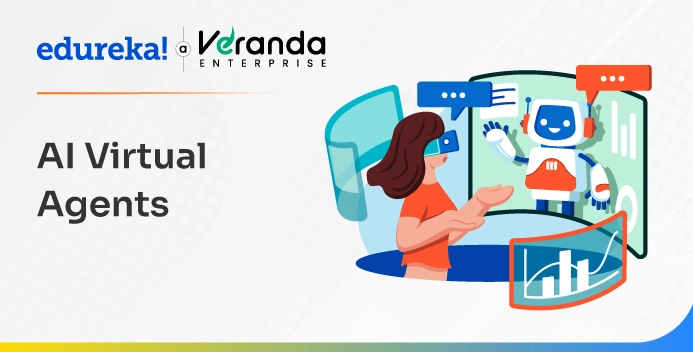










 REGISTER FOR FREE WEBINAR
  Thank you for registering Join Edureka Meetup community for 100+ Free Webinars each month JOIN MEETUP GROUP