Agentic AI Certification Training Course
- 130k Enrolled Learners
- Weekend/Weekday
- Live Class
(63442)


 Copy Link!
Artificial Intelligence (AI) is no longer limited to simple rule-following models but has developed into very smart agents able to make difficult decisions. Among these, the utility-based agent in AI can be regarded as the most advanced one because of its capability to select the most advantageous action by evaluating the outcomes and the preferences. It does not limit its action to goal attainment; rather, it goes one step further to maximize pleasure or “utility.”
This guide describes the concepts of a utility-based agent, its functioning, advantages, and some real-life applications.
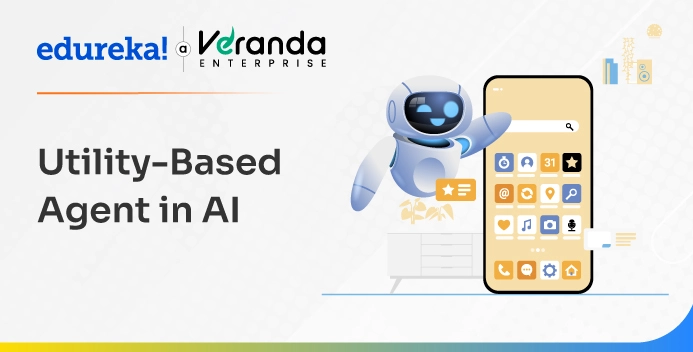
A utility-based agent in AI is an intelligent system that uses a mathematical model called a utility function that assigns a value to each possible outcome to determine its actions. The main goal is to pick the action that gives the greatest total satisfaction or utility.
These agents do not simply look for what is “right” or “wrong” but assess the effect of each action and choose the best one in accordance with the preferences, likelihoods, or the state of the environment.
An AI utility-based agent undergoes the following systematic steps to execute rational decisions:
Example: In a recommendation engine for e-commerce, the agent estimates which product suggestion would provide the user with the greatest level of satisfaction.
These agents use various crucial components as the basis for their efficient performance:
The combination of all these parts helps the agent to cope with uncertainty and to choose the course of action that, in the end, will be the best, even if the environment is tough.
Employing a utility-based approach in AI system not only increases the effectiveness of the AI systems but also opens up new avenues for research and development:
Utility-based agents are extensively employed in industries where dynamic decision-making is vital:
These applications are proof that utility-based agents are the ones that connect human reasoning and machine efficiency.
To better understand how a utility-based agent differs from other AI models, here’s a quick comparison highlighting their decision-making approach, adaptability, and typical use cases:
| Agent Type | Decision Basis | Learning Ability | Adaptability | Example Use Case |
|---|---|---|---|---|
| Simple Reflex Agent | Fixed condition–action rules | None | Low | Automatic doors |
| Model-Based Agent | Uses internal model | Limited | Moderate | Robot navigation |
| Goal-Based Agent | Acts to achieve defined goals | Basic | Moderate | Task-planning bots |
| Utility-Based Agent | Maximises utility/satisfaction | High | High | Self-driving cars, trading bots |
In essence, while goal-based agents focus on achieving objectives, utility-based agents focus on maximising overall benefit.
Utility-based agents possess several weaknesses, including:
These challenges render the development of such agents technically difficult yet very rewarding.
The next step for utility-based agents lies in the fusion of highly developed learning models and the application of ethical decision-making paradigms. Among the trends, we see:
With AI progression, the utility-based system is foreseen to be a major factor in rendering AI more human-like and value-centric.
A Utility-based agent in AI symbolizes a drastic change from rule-following systems to an intelligent entity that makes decisions based on objectives and optimizations. By associating values with results and picking the actions that give the most satisfaction, these agents bring forth more intelligent, more flexible, and AI systems that are more aware the context.
Utility-based agents are the building blocks of the next generation of smart technologies that will not only comprehend human-like preferences but also provide the best solutions in all sectors.
Upskill in AI with a specialized Agentic AI certification training course, focused on building, deploying, and managing autonomous AI solutions for real-world applications.
What does a utility function do in an AI agent?
A utility function quantifies the desirability of various outcomes and thus assists the agent in selecting the action with the greatest total benefit.
What are the main differences between a utility-based agent and a goal-based agent?
A goal-based agent is concerned only with the process of attaining a specific goal, whereas a utility-based agent works towards the optimal result through outcome comparison.
Are utility-based agents ever utilized in reinforcement learning?
Yes. Usually, they are connected with reinforcement learning to evaluate and improve actions based on the expected utility and reward signal.
What industries reap the biggest rewards of utility-based AI?
The sectors of health care, finance, robots, and online shopping are the main winners since they all depend on the choices made by using data and having the power to change the choices.
Can the utility-based agent learn and modify itself during its entire lifetime?
Yes. The agents are capable of refining their utility functions and thus the quality of their decisions over time, when combined with learning algorithms, up to the point that the quality of decisions increases gradually.









 REGISTER FOR FREE WEBINAR
  Thank you for registering Join Edureka Meetup community for 100+ Free Webinars each month JOIN MEETUP GROUP