Agentic AI Certification Training Course
- 135k Enrolled Learners
- Weekend/Weekday
- Live Class
(63442)


 Copy Link!
Artificial Intelligence (AI) depends on the use of various agents for decision-making and problem-solving. One of them is the logical agent in artificial intelligence and has a special function; it applies reasoning and knowledge representation to infer conclusions, similarly to people.
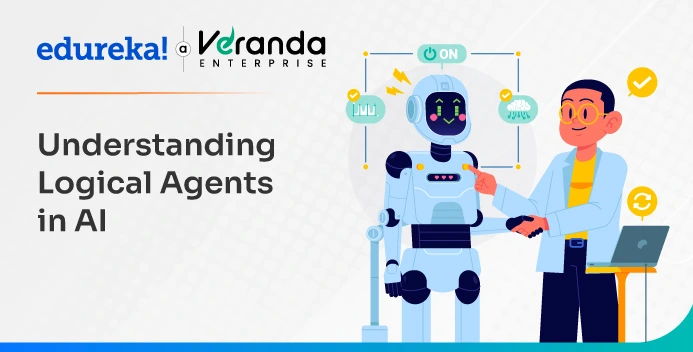
A logical agent in artificial intelligence is a system that employs formal logic as a basis for its decision-making process. Instead of choosing its actions at random or relying solely on data, it applies facts, rules, and reasoning in order to reach the answers.
It lives by the “think first, act later” rule, which means it comprehends the knowledge that is available before taking any action.
Key Concept: Logical agents use symbolic logic to represent what they know about their environment and apply inference techniques to deduce new knowledge from the known facts.
A logical agent excels by inferring and reasoning from known information, allowing it to interpret even incomplete or ambiguous data.
For example, a logical reasoner who has knowledge that every human is mortal and Socrates is a human can, through inference, conclude that Socrates is mortal.
There are two main reasoning methods:
Example: “All the vehicles need fuel → Tesla belongs to the category of vehicles → hence, it needs fuel (if the rule is followed).”
Example: “The sun has risen every day so far → therefore, it is going to rise tomorrow.”
Logical agents rely on knowledge representation systems, which, at the same time, allow them to store, comprehend, and even change information according to their needs.
The methods frequently used are:
Logical agents are designed with the attributes that allow them to think, reason, and act in an intelligent manner.
The following are the main characteristics:
Logical agents not only represent a theoretical concept but are also applied in the sectors that require decision-making based on consistency and rules.
A couple of their practical applications are:
The building of logical agents is based on a high-level workflow that is composed of a series of methodical actions that determine the inference and behavior of the agent:
Though powerful, logical agents still come across a good number of drawbacks which limit their practical application:
The future of logical agents is in the integration of AI’s logical reasoning with contemporary learning models, such as neural-symbolic AI.
The hybrid model provides the capability to:
Such advancements will make knowledge representation in AI agents more adaptable and context-aware, bridging the gap between data-driven and rule-driven intelligence.
The logical agent in artificial intelligence is still the pillar of reasoning-based AI. Its capacity for logic application, inference, and structured knowledge makes it vital in the fields where transparency and reliability are required. Even with the advent of hybrid AI models, logical agents will still be leading the charge in the development of intelligent, explainable, and trustworthy systems.
Advance your career in AI with an Agentic AI course with certificate, focused on building and deploying autonomous AI solutions.
What distinguishes a logical agent from a reactive agent?
A logical agent determines its action by reasoning, while a reactive agent acts immediately to the stimulus.
Is it possible for a logical agent to learn new rules on its own?
Traditional logical agents are not capable of this; however, contemporary AI models, which combine different approaches, allow logical agents to level up their reasoning skills by means of experience.
What are the criteria for choosing between a logical agent and a machine-learning agent?
If you need transparent, rule-based reasoning, a logical agent is the way to go; if you are working with large amounts of unorganized data, then machine learning is the option to consider.
How difficult is it to create a logical agent for a real-world domain?
The whole process can be very intricate as it involves generating all the logical rules and, at the same time, maintaining an accurate knowledge base.
Are logical agents still relevant in the age of deep learning?
Yes. They not only coexist with deep learning but also enhance it by providing AI systems with the qualities of explainability, structured reasoning, and trust.














 REGISTER FOR FREE WEBINAR
  Thank you for registering Join Edureka Meetup community for 100+ Free Webinars each month JOIN MEETUP GROUP