Agentic AI Certification Training Course
- 136k Enrolled Learners
- Weekend/Weekday
- Live Class
(63442)


 Copy Link!
Have you ever thought about the fact that machines have the ability to make instant decisions without really thinking? Well, that’s the basic functioning of simple reflex agents in AI. They are among the most basic yet important types of AI agents, operating solely on if-then rules. Even though they are simple, they provide a basis for comprehending how intelligent systems interact with environments.
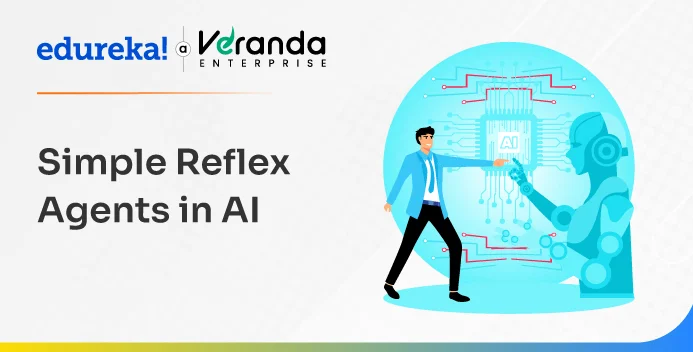
This guide describes what a simple reflex agent is, how it works, its properties, applications in real-world scenarios, and its importance today.
A simple reflex agent in AI is an intelligent device that responds to the current condition without taking into account any prior information or history. It operates on the basis of a rule-based system where it applies pre-established if-then conditions to make its decisions.
For example:
If the room temperature goes beyond the set limit, the fan turns on.
If an object is detected, the system either stops or changes direction.
These agents do not learn or improve with experience. Their behavior is based only on the current input and a fixed set of predefined rules.
Simple reflex agents are based on a perception-action cycle. This means that they are aware of their environment and react immediately according to what they are aware of.
Here is a simplified step-by-step outline:
For instance, a vacuum cleaner robot, which turns when it encounters an obstacle is a good case; it does not consider the past; it simply responds.
Simple reflex agents have basic characteristics that make them simple to comprehend yet very limited in complexity.
There are two fundamental parts of the simple reflex agent architecture:
The process can be illustrated as:
Environment → Sensors → Condition-Action Rules → Actuators → Action
The rules are kept in a rule base, which is the agent’s source of knowledge. The agent’s every decision is based on these preset rules.
Example:
If the “light level is less than the threshold” then the “light will be switched on.”
The simple design permits fast reactions but it is not adaptable and intelligent.
One of the best and most straightforward simple reflex agent examples is an automatic door sensor system.
How it works:
Apart from this, there are other examples such as:
All of them work only on the basis of a predefined if-then logic without any memory or prediction power.
Although each of them fall under the types of reflex agents in AI, their main difference lies in the way they manage the knowledge.
| Feature | Simple Reflex Agent | Model-Based Reflex Agent |
|---|---|---|
| Memory | No memory; reacts to the current state only | Maintains an internal model of the world |
| Flexibility | Has limited flexibility | It is more adaptable |
| Complexity | Simple rule-based | More advanced and dynamic |
| Example | Thermostat | Self-driving car that detects hidden obstacles |
Model-based agents can predict or infer hidden aspects of the environment, while simple reflex agents cannot.
Even though they are basic, simple reflex agent applications can be found in every aspect of technology that we use on a daily basis.
These applications reveal the capability of basic reflex agents to take care of repetitive tasks that are well defined.
The implementation of a simple reflex agent in AI, just like any other AI system, has its pros and cons. It is excellent in strictly controlled and rule-based environments but has difficulties in dealing with unpredictable or varying situations.
Understanding both aspects allows recognizing the most appropriate situations for the deployment of these agents.
Advantages:
Limitations:
Therefore, these agents, although reliable, are still not suitable for complex problem-solving involving the use of context or learning.
Although modern AI techniques include learning and reasoning, the simple reflex agent in AI remains an educational and practical tool.
Understanding simple reflex agent builds a strong foundation for learning more complex intelligent agent architectures.
A simple reflex agent in AI is a rule-based system that reacts immediately to the inputs from the environment using the predefined if-then rules. Although these agents have restrictions in learning and adaptability, they are still very important for simple automation applications such as thermostats, robots, and sensors.
Understanding the concept of simple reflex agents thoroughly will allow the learners to gradually move to the more sophisticated AI systems, for instance, model-based or goal-based agents, with ease.
What is a simple reflex agent in AI?
A simple reflex agent is an AI that responds to its surroundings through preset if-then rules and does not keep past data.
What are some simple reflex agent examples in the real world?
Examples of such agents comprise thermostats, automatic doors, simple robots, and vending machines. All of them operate on the basis of sensors and instantaneously react to the inputs they get.
What is the difference between a simple reflex agent and a model-based reflex agent?
A simple reflex agent only responds to the present situation, whereas a model-based agent remembers to deal with the parts of the environment that are not visible.
What are the limitations of simple reflex agents in AI?
Their limitations are the inability to learn, remember, or modify them to the various situations that surround them making them unsuitable for complicated or unstable environments.
Why are simple reflex agents important for beginners learning AI?
They give a clear and simple framework to understand how agents see the environment and respond, thus providing the base for the study of advanced AI frameworks.










 REGISTER FOR FREE WEBINAR
  Thank you for registering Join Edureka Meetup community for 100+ Free Webinars each month JOIN MEETUP GROUP