Agentic AI Certification Training Course
- 136k Enrolled Learners
- Weekend/Weekday
- Live Class
(63442)


 Copy Link!
Today, AI systems are not only reacting to the world but also comprehending it. Model-based agent in AI is one of the best illustrations of this development. Such agents rely on their internal models to discern the environment, choose the best course of action, and even make very smart adjustments to their decision when changes occur.
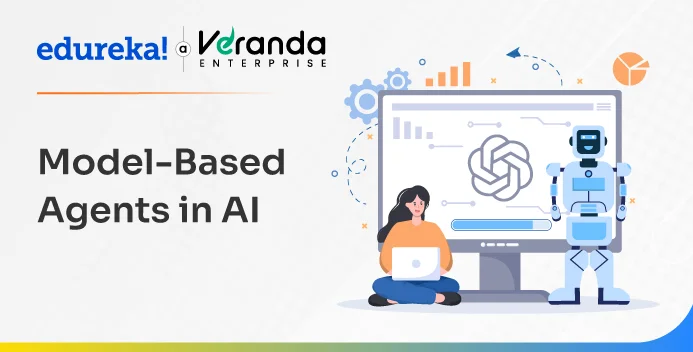 This guide explains what model-based agent systems are, how they work, their components, and why they’re vital in modern AI systems.
A model-based agent in AI is a smart system that creates a mental image of its surroundings and uses it to decide what to do. Rather than just reacting, it combines its knowledge to arrive at a decision that is both informed and rational.
It is similar to a device that “holds” in its memory what it has witnessed in the past and estimates the next possible scenario.
For instance, a model-based reflex agent operating a vehicle does not merely take the present hindrances as a signal to act; it speculates the behavior of other cars and traffic lights, too.
To make smart decisions, agent-based models consist of a model, which is a data structure that portrays the state of the environment, changes, and rules governing the environment.
They utilize this model to:
For instance, a virtual assistant that is able to predict your next command based on past interactions can be considered an agent that employs a model-based intelligent agent framework.
A standard model-based intelligent agent encompasses a few important parts:
The primary distinction of model-based agents is their ability to keep a record of the world. The majority of basic AI agents do not possess this feature.
To illustrate their differences:
| Agent Type | Description | Key Difference |
|---|---|---|
| Simple Reflex Agent | Reacts directly to the current input. | No memory or internal model. |
| Model-Based Reflex Agent | Uses past and present data to decide. | Has an internal model for context. |
| Goal-Based Agent | Chooses actions to achieve specific goals. | Often builds on model-based logic. |
| Learning Agent | Improves over time using feedback. | Can evolve beyond model-based logic. |
A model-based reflex agent acts as a bridge between simple reactive systems and advanced learning systems.
The workflow of a model-based agent in AI is systematic and logical.
Step-by-step process:
This loop continues repeatedly, making the agent gradually better in its comprehension and choices.
Model-based reasoning is a general concept that can be found in many areas, such as self-driving cars or recommender systems.
Some of the common applications of model-based agent examples are:
Each model-based agent example illustrates the way machines mimic the real world understanding to arrive at logical, safe, and efficient decisions.
Model-based agents are the cornerstones of intelligent and adaptable AI systems. They empower machines to understand the scenario and make reasonable choices. However, like every other AI model, they have their own limitations that impact their effectiveness and scalability.
Benefits:
Limitations:
Challenges in Model-Based Agents Creation
The creation of the efficient AI model-based agents faces the most important problems given below:
Despite these challenges, modern AI frameworks are making such agents quicker and more intelligent.
The future of the technology of model-based intelligent agents is in the joining of modeling and learning. Among the trends that are emerging, the following are the most prominent ones:
As AI progresses, model-based methods will be at the center of reasoning and prediction.
A model-based agent in AI utilizes its knowledge base to understand, predict, and act intelligently in a difficult environment. It is a step forward from the primitive reflex systems in that it is not merely reacting but rather “understanding” what is taking place.
As the tendency of industries towards autonomous systems continues to grow, model-based agents will play a key role in the making of AI that is capable of thinking, adapting, and making trustworthy real-world decisions.
Upskill in AI with a specialized Agentic AI certification training course, focused on building, deploying, and managing autonomous AI solutions for real-world applications.
What is a model-based agent in AI?
A model-based agent is an intelligent system that relies on an internal representation of its environment to perform its actions in a clever way.
How does a model-based reflex agent work?
It perceives the environment, refreshes its internal representation, and then selects the optimal action considering both the history and the present situation.
What are some real-world model-based agent examples?
Some examples are automated vehicles, forecasting health care systems, and smart speakers such as Alexa.
What is the significance of model-based reasoning in AI?
It allows machines to reason, predict the outcomes, and change their decisions with great accuracy according to the different situations.
How does a model-based agent differ from a learning agent?
A model-based agent relies on the current logic while a learning agent gradually improves its performance on its own through the means of experience.









 REGISTER FOR FREE WEBINAR
  Thank you for registering Join Edureka Meetup community for 100+ Free Webinars each month JOIN MEETUP GROUP