Agentic AI Certification Training Course
- 135k Enrolled Learners
- Weekend/Weekday
- Live Class
(63442)


 Copy Link!
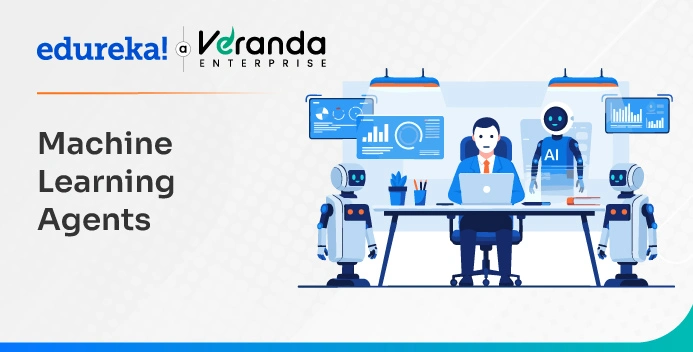
Artificial Intelligence is evolving from passive prediction tools to active, goal-oriented systems, called machine learning agents. While AI models continue with more advanced data analysis, they are still reactive, they will respond only when called upon.
Machine learning agents represent the next step in that evolution. These smart systems can perceive events around them, make decisions, and then independently take the required actions to achieve objectives, without continuous human governance.
As McKinsey’s April 2025 report, “Smart AI agents will radically change how we think about autonomization,” businesses are moving from static models to adaptive ones that make decisions, learn and act on their own.
AI models are computer systems trained to find patterns, make predictions or generate content. These models are passive in that they’re waiting for input and give a response only after an input is requested of them. They are like expert consultants, they give fantastic advice but need others to ask questions and take action themselves.
An autonomous system is one that can make decisions and act independently, without the intervention of humans. Examples include self-driving cars and robots that operate warehouses. These systems must understand their environment, make decisions based on that understanding, act upon those decisions, and respond to changes in conditions over time. The challenge is really how to combine these skills so that the system can handle the uncertainty and yet fulfill its objectives.
The machine learning agent is a software entity that autonomously perceives its environment, processes information, makes decisions, and executes actions to achieve predetermined goals. In contrast to traditional AI-based models that only give answers to questions, machine learning agents are independent and constantly change their behavior according to environmental feedback they have observed, learned, and adapted to during their life cycle.
To begin learning the basics of machine learning, refer to this comprehensive Introduction to Machine Learning Guide by Edureka.
Several mechanisms make machine learning agents turn static AI models into active and autonomous systems.
Machine learning agents offer transformative advantages across multiple dimensions:
Such agents of machine learning can bring about a very high level of operational efficiency through automation of complex workflows and continuous work without breaks. They take over the roles that require repetition and intensive data handling with a great degree of precision, thus saving time and producing output with consistent quality.
They increase the quality of decision-making by the means of real-time analyzing of large datasets and revealing patterns that are invisible to humans, the agents’ decisions are then backed by data not intuition, and thus they are more precise and impartial.
In contrast to the traditional workforce, which grows proportionately with the demand, machine learning agents offer an easy and cost-effective way of scaling the operations up or down: Several instances can be deployed simultaneously allowing the organizations to cope with the changing workloads without much effort and at lower costs.
Machine learning agents are built to offer personal user experiences on a large scale.Contextual understanding enables them to personalize every response, recommendation, and service for each user to keep engagement levels high.
Equipped with mechanisms for learning, machine learning agents continuously evolve through experience. They continue to refine their models and processes of decision-making, increase their effectiveness, and transform into self-improving systems with increasing value while operating.
To learn more about how to build and deploy AI-driven agents, refer to the Agentic AI Training Course by Edureka.
Machine learning agents currently transform operations across virtually every industry sector.
Medical agents support diagnosis through the analysis of patient data, imagery, and clinical records which allergen the physician to take decisions. They are real-time patient monitors, provide alerts to the healthcare providers in case of changes, and even perform automated tasks such as scheduling and documentation.
Financial agents use anomaly detection in transaction patterns to identify fraud. They make personalized investment recommendations that are appropriate for the risk profiles of their human counterparts. Trading and risk management agents execute strategies at very high speed and monitor portfolios continuously against threats.
Agent bots manage customer inquiries on various platforms by solving the basic problems quickly and passing them on to the human staff when the situation gets convoluted. They can be connected at any time, keep the same communication thread going throughout the interactions and become better through reinforcement learning.
The assistants are responsible for streamlining the production process, forecasting machine upkeep, and managing the freight. They are very proactive against any interruptions by either diversion of shipments or alteration of plans so that it costs less and takes less time.
Research agents facilitate the process of innovation by not only proposing hypotheses but also designing experiments and analyzing results. They sift through data in bulk and direct researchers towards new fields and possible breakthroughs.
Code generation agents support developers with code writing, testing, and optimization. They detect vulnerabilities in code, provide assurance of best practices, and improve productivity through automated intelligent coding assistance.
Even though machine learning agents are highly promising they are still up to the marked with huge challenges in the following areas:
As machine learning agents become more autonomous, questions of responsibility become very complicated. Where does the liability lie: with developers, deployers, or the agent? When the agent acts without direct human oversight, especially, such questions pose major ethical and legal difficulties.
Agents can inherit biases from their training data, which is leading to unfair or discriminatory outcomes in areas such as hiring or lending. Fairness will, therefore, require a diverse set of data, bias detection, and continuous monitoring across development and deployment.
Most agents are “black boxes,” and it is hard to trace how they arrived at their decisions. This lack of transparency hinders accountability and user trust, hence pushing the need for explainable AI techniques that clarify how agents reach conclusions.
Since agents deal with sensitive data very frequently, privacy and security become crucial concerns. For this purpose, organizations must implement strict measures to avoid misuse, ensure compliance, and protect personal information while enabling the performance of agents effectively.
Highly conversational agents, therefore, blur the line between humans and machines; if their use is not clearly disclosed to users as being non-human, they may further the potential for user deception or be used to manipulate and mislead others.
Machine learning agents, representing a defining advance in the development of artificial intelligence, provide the missing link in completing the loop from predictive models to full autonomy. But success relies on ethical design, transparency, and human oversight. As they evolve, machine learning agents are going to magnify human potential by undertaking routine tasks and freeing people to work on strategy and creativity.
Accelerate your AI career with a specialized Agentic AI certification course that emphasizes building and deploying autonomous AI systems.
What differentiates a machine learning model from a machine learning agent?
The model in a machine learning application forecasts the result while the agent makes the choice to perceive, decide, and act in the way that will lead to the realization of the goal.
What techniques do machine learning agents use to learn and get better with time?
They will learn through constant feedback that death will be either by supervision, reinforcement, or meta-learning which will be done while refining the decisions and being able to accommodate new information.
In what areas of the present world are machine learning agents used?
Among the many and varied applications are chatbots, fraud detection systems, algorithmic trading bots, medical diagnostic assistants, and logistics optimization agents.
What are the main skills and competencies that would be needed when dealing with machine learning agents?
The main skills are: machine learning understanding, Python programming, AI tools, software design, and application-specific domain knowledge.
What are the main ethical issues that arise when machine learning agents are used?
Among the main concerns are bias, accountability, privacy protection, transparency, and the need to ensure that human values and legal standards are maintained.









 REGISTER FOR FREE WEBINAR
  Thank you for registering Join Edureka Meetup community for 100+ Free Webinars each month JOIN MEETUP GROUP