Agentic AI Certification Training Course
- 135k Enrolled Learners
- Weekend/Weekday
- Live Class
(63442)


 Copy Link!
Imagine machines that don’t just follow orders but actually learn from every move they make. That’s the promise of learning agents, the driving force behind the new generation of intelligent, self-improving AI systems.
Learning agents are continuously adaptive unlike the traditional models, which do not change on training. They look around, examine the results, and optimize their decisions each time they encounter someone. This paradigm is transforming businesses, with self-driving vehicles to foresight healthcare. Indeed, 78% of organizations said that they were using AI in production in 2024, a definite shift towards autonomous, experience-based intelligence.
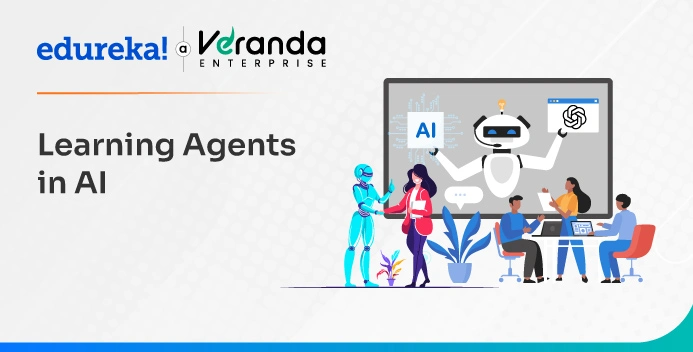
This guide will discuss how learning agents in AI change over time, how they learn, how they are deployed in the real world, and the technology driving the next great step in AI autonomy.
A learning agent is an artificial intelligence system that senses its surroundings, performs actions, receives feedback, and uses that feedback to enhance its future performance.
According to the definitions:
Traditional AI models, rule-based systems, and static ML models may handle known scenarios but frequently fail to adapt when the environment changes. A learning agent, in contrast, is designed to evolve. This makes it particularly useful in settings where variables change rapidly, data never stops flowing, and decisions must evolve in real time.
The main quality that distinguishes a learning agent is its ability to grow and perform better through experience, making improvements by adapting its behavior.
Here are the main steps in the evolutionary process:
Experience is more than data. It includes meetings, outcomes, mistakes, and real events. Unlike rigid software, agents learn and change. A recommendation system that updates its understanding based on user behavior is not just reacting, it is evolving.
Learning agents can use different learning models, and each one works best in a certain situation or job. The types of learning agents in AI are shown below.
This kind of learning starts with teaching it pairs of named inputs and outputs. The robot learns how to connect inputs to the right outputs with this method.
Unsupervised learning enables an agent to find patterns or structure in unlabeled data.
Reinforcement learning (RL) uses rewards and punishments rather than unambiguous signals to train agents through trial and error. The agent acts in a certain setting, watches what happens, and then changes how it acts to get the most total reward.
Continuous learning (sometimes called online learning or lifelong learning) refers to agents that keep absorbing new data and adapting their models on-the-fly rather than being trained once and deployed static.
Multi-agent learning occurs when numerous learning agents interact or collaborate in the same environment. They can compete, discuss plans, and develop ‘team intelligence’.
Once confined to experimental environments, learning agents in AI have become part of practical, real-world applications. Today, they guide autonomous cars and intelligent assistants capable of understanding human intent. Through ongoing learning and instant decision-making, these systems are transforming how industries operate.
Self-driving cars are powered by learning agents. They perceive roads, traffic, and obstacles, make decisions, receive feedback (safe passage, near-miss, crash), and alter policy. Experience helps these agents handle edge-case occurrences, unexpected human drivers, and changing weather.
In platforms like streaming services or e-commerce, learning agents analyze user behavior, adapt suggestions, and learn user preferences dynamically. They move beyond static models to continuously refine recommendations in response to user interactions, session feedback, and external trends.
Learning agents help diagnostic systems adapt to patient data. They can learn to detect patterns (imaging, genomics, vitals), adapt to novel disease variants, and tailor treatment recommendations. Medicine requires ongoing learning as new illnesses and therapies develop.
Voice-driven or robotic assistants apply learning algorithms to comprehend user speech, ensure relevant dialogue, store important details from previous talks, and coordinate various tasks. Another thing robotics agents do is gain experience, which allows them to improve their navigation, manipulation, problem-solving, and collaboration skills with humans and other machines.
To realize learning agents in AI practice, a combination of advanced technologies is required.
Deep neural networks provide the representation-learning backbone for agents, enabling raw data (images, speech, sensor streams) to be transformed into useful features, decisions to be modeled end-to-end, and adaptation to new data. Without strong representation learning, an agent cannot effectively interpret complex inputs.
Learning agents rely on large volumes of data (historical, streaming) to learn effectively. Cloud computing infrastructures provide the scalability, storage, compute power, and distributed training platforms needed for learning-at-scale. The availability of data and compute is thus critical.
Frameworks like OpenAI Gym and TensorFlow Agents offer a complete set of APIs, modeling tools, and resources that help developers and learners design, train, and deploy intelligent learning agents effectively.
Over time, learning agents will continue to develop in several meaningful ways:
To “agents that learn once and act” toy “agents that continuously evolve, collaborate, and self-improve in real-world complex systems” is the future.
The rise of learning agents marks a major shift in AI, from fixed, rule-driven systems to dynamic models that learn from experience. This discussion examines how learning agents are developed, the frameworks guiding them, their practical uses, and the technology that enables their progress.
Planning companies see learning agents as long-term investments, not technology refreshes. Their capacity for self-learning and adaptation makes these systems essential for fostering innovation and ensuring long-term growth in dynamic industries.
Want to discover how these learning agents can advance your AI strategy?Here’s what comes next.
What is a learning agent in artificial intelligence?
A learning agent in AI is designed to observe and respond to its environment, take feedback into account, and enhance its actions through experience rather than relying on predetermined rule sets.
How do learning agents differ from traditional AI models?
Traditional AI models operate on static data and fixed logic. Learning agents, however, continuously adapt by learning from new experiences and adjusting their behavior in real time.
What are some real-world examples of learning agents?
Self-driving cars, recommendation engines, smart healthcare diagnostic tools, and robotics that learn and improve are powered by learning agents.
What are the main challenges in building learning agents?
Maintaining data integrity, safeguarding system stability, preserving learned knowledge, tackling ethical issues, and controlling heavy computational workloads are key responsibilities for developers.
How will learning agents shape the future of AI?
They will enable AI systems that are truly autonomous, continuously improving, and context-aware, ushering in an era of adaptive, self-evolving intelligence.







 REGISTER FOR FREE WEBINAR
  Thank you for registering Join Edureka Meetup community for 100+ Free Webinars each month JOIN MEETUP GROUP