Agentic AI Certification Training Course
- 134k Enrolled Learners
- Weekend/Weekday
- Live Class
(63442)


 Copy Link!
Did you know that many of today’s intelligent systems are not just powered by data and machine learning, but by structured knowledge and reasoning? In artificial intelligence (AI), knowledge-based agents are computer programs that can store, reason over, and act on specific knowledge. They excel in tasks requiring clarity, rationality, and skillful decision-making. In an era when raw data drives many models, agents that incorporate domain knowledge and rules provide complementing benefits.
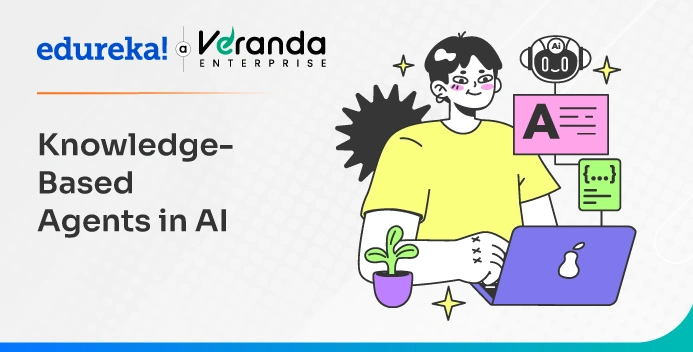
This guide examines what knowledge-based agents in AI are, the types of knowledge they handle, how they are built, real-life applications, benefits, challenges, and how the field is heading towards hybrid and self-evolving agents.
A knowledge-based agent in artificial intelligence applies logical reasoning through an inference engine that works with a detailed knowledge base of facts, rules, and heuristics, instead of depending purely on data pattern recognition.
In contrast to simpler reactive or goal-based agents, knowledge-based agents maintain an internal state of knowledge, update it when receiving percepts, and use reasoning (e.g., deduction, abduction) to infer new facts and select actions.
This distinction means:
Knowledge-based agents are intelligent systems that are built around organized, explicit knowledge and reasoning. They enable more transparent decision-making and interpretability than many black-box learning methods.
When creating knowledge-based agents in AI, it is critical to identify the sorts of knowledge that the system will handle. There are four major types of knowledge-based agents in AI:
Declarative knowledge refers to knowledge of facts and relations (the ‘what”). Examples: “Paris is the capital of France”, or “If a patient has symptom X and test Y, then disease Z is possible.”
This is typically represented in logic sentences, rules, ontologies or knowledge graphs. It forms the backbone of many knowledge bases.
Procedural knowledge is knowledge of how to do things, the “how”. For example: “To diagnose disease Z, perform test A, then interpret result B, then consult expert rule C.”
In an agent, procedural knowledge may encode algorithms, workflows or methods for achieving tasks. This blends with procedural reasoning systems (PRS) in AI.
Meta-knowledge refers to knowledge about the knowledge or about how knowledge is used, for example: “When fact X is unknown, ask the user for input.” Or “If inference takes more than 2 seconds, switch to heuristic rule.”
Meta-knowledge gives the agent the capacity to monitor, adapt or control its reasoning.It is higher-level knowledge.
Heuristic knowledge is experience-based, approximate rules of thumb, for example: “If a customer has logged support issues more than twice this month, escalate automatically.” Heuristics may not be ideal, yet they are useful and efficient.
This type of knowledge is useful in knowledge-based agents when dealing with complexity or inadequate information.
To design knowledge-based agents in AI, you must first grasp its fundamental components and architecture. The primary elements are:
The knowledge base contains domain knowledge (facts, rules, heuristics, and meta-rules). It is described using a knowledge representation language, such as first-order logic or ontologies.
The KB encourages questioning and thinking. The agent has two options: TELL (contribute) or ASK (search) the knowledge base.
The inference engine is the reasoning component that collects information from the knowledge base and applies logical or heuristic rules to generate new knowledge or make decisions about actions. Forward chaining, backward chaining, and abduction are some common reasoning processes.
Though less emphasized in many software-only agents, real agents typically include sensors (perception mechanisms) and actuators (execution mechanisms).
Here is a practical guide to building your own knowledge-based agent.
Knowledge-based agents prove highly effective in fields where structured information and logical analysis are essential. Below are some of the main areas where they are commonly applied:
In healthcare, knowledge-based agents can assist diagnostics, treatment planning, and monitoring. For example, the agent can use medical procedures, patient history, symptoms, and test findings to make diagnoses or recommend future measures.
In finance, agents can analyse rules, regulations, risk models, market facts and historical data to advise on investment decisions, credit underwriting, fraud detection or regulatory compliance.
In manufacturing, knowledge-based agents can support fault diagnosis, process optimisation, predictive maintenance and workflow management by encoding domain heuristics, machine-status facts and decision rules.
In robotics, knowledge-based agents provide high-level reasoning: planning paths, reacting to sensor data based on rule sets, handling exceptions and interacting with humans or other systems. They work alongside machine-learning subsystems.
Knowledge-based agents are useful in both rule-based and expert-driven areas because they have many strategic benefits.
Despite their advantages, developing these agents involves several hurdles:
Advancements in artificial intelligence are playing a growing role in shaping how knowledge-based agents are developed.
Knowledge-based agents use structured information, logic, and domain experience to make visible, verifiable expert-level decisions in fields like healthcare, banking, and manufacturing. While data collection and scalability challenges persist, hybrid agents that combine rule-based reasoning with data-driven learning represent the future. Expert logic and explainable reasoning are essential for designing such systems.
Advance your career in AI with an Agentic AI training course focused on building and deploying autonomous AI solutions.
What makes a knowledge-based agent different from other AI systems?
This system differs from typical AI models by using an inference engine that draws conclusions from stored facts and rules rather than simple input–output mapping.
How do inference engines in knowledge-based agents work?
By employing rules through forward or backward chaining, they derive new facts, refresh the knowledge base, and determine the next steps.
What are common examples of knowledge-based systems?
Expert systems in medicine, financial advisory tools, manufacturing decision-support systems, and rule-based robotic planners.
What are the advantages of using a knowledge-based approach?
It ensures explainable reasoning, reuses expert knowledge, works well with limited data, and meets compliance standards.
How can these agents integrate with machine-learning models?
By combining logical rules with data-driven insights, where ML suggests new rules or enhances the knowledge base dynamically.








 REGISTER FOR FREE WEBINAR
  Thank you for registering Join Edureka Meetup community for 100+ Free Webinars each month JOIN MEETUP GROUP