Agentic AI Certification Training Course
- 133k Enrolled Learners
- Weekend
- Live Class
(63442)


 Copy Link!
Artificial Intelligence (AI) has undergone a significant transformation from executing simple tasks to managing complex, decision-making systems. The intelligent agent in AI, which is a fundamental concept enabling machines to sense, comprehend, and act independently, is at the center of these innovations.
This article explores intelligent agents, their features, nature, types, structure, and real-world uses that are so essential in the present-day AI-centric world.
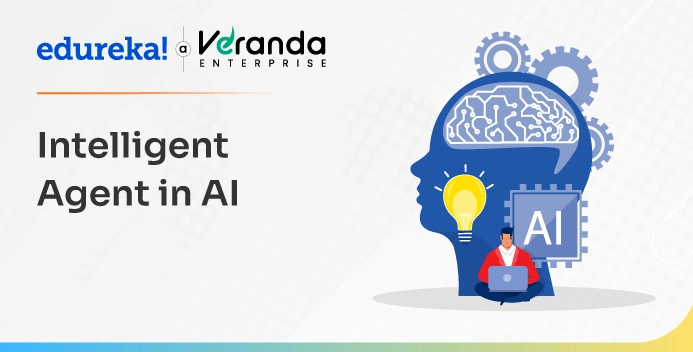 What Is an Intelligent Agent in AI?
An intelligent agent in AI is a system capable of perceiving the environment, processing the information, and then taking actions in order to reach certain objectives. The functioning of such agents is autonomously, which means that the agents do not require human supervision to carry out their activities.
An intelligent agent operates through a continuous perception-action cycle, taking input data, using algorithms to process it, and then implementing the action that is best among all possible ones.
Example: A self-driving car uses sensors (for example, cameras and radar) to understand its environment and make decisions like braking, turning, or speeding up based on the information it has.
The characteristics of intelligent agents determine their operating efficiency and adaptability to different environments. The key characteristics include:
Artificial Intelligence (AI) incorporates various types of intelligent agents that can execute their tasks using different methods depending on the environment. Some categories that are mainly distinguished are as follows:
These agents solely respond to the current situation and disregard the past entirely.
These agents maintain an environment’s internal representation and utilize it to make more thoughtful decisions.
These agents make their choices depending on how near each action takes them to their goal.
The main objective of these agents is to achieve the highest level of satisfaction or utility via the selection of the most advantageous action.
Learning agents rely heavily on their experiences or training data for their continuous improvement.
All these types of intelligent agents are very important in the development of the AI systems overall, their impact being proportional to the environment’s complexity.
The architecture of an intelligent agent in AI defines its perception, reasoning, and action modes. The most widely used architectural models are:
The typical intelligent agent structure is composed of:
Smart agents operate on an endless feedback loop, which is referred to as the perception-action cycle, which comprises the following stages:
This loop system allows intelligent agents to be self-operating, learn from the results, and become better over time, making them ideal for dynamic and unpredictable environments.
Intelligent agents play a crucial role in various real-world applications, enhancing industry productivity and user satisfaction. The following are scenarios where intelligent agents are implemented:
These examples of intelligent agents are a clear indication of how AI simplifies tasks, saves time, and enhances the overall experience of users.
The deployment of intelligent agents comes with multiple benefits:
Despite the many advantages that intelligent agents have, they come with some challenges:
The future of intelligent agent in AI will be defined by enhanced autonomous decision-making, collaborative capabilities, and real-time responsiveness. With the progress made in deep learning and reinforcement learning, agents will be more aware of the context and able to make decisions similar to those of humans.
These innovations are anticipated to bring significant advantages to the sectors of healthcare, smart cities, and cybersecurity, resulting in the development of advanced, secure, and interconnected systems.
An intelligent agent in AI is the brain behind modern automation, monitoring, reasoning, and performing actions to accomplish goals effectively. Understanding the types of intelligent agents, their traits, and the examples of their application in real life gives a clear view of the working of AI systems and their contribution to human life. With the progress of technology, intelligent agents will be the main drivers of the upcoming innovations in the industrial and consumer areas.
What are intelligent agents in artificial intelligence?
They are the systems that observe their surroundings, analyze the information, and take independent actions to realize their individual goals.
What are the main categories of intelligent agents?
Simple reflex, model-based, goal-based, utility-based, and learning agents are the ones that constitute the main types.
What is the distinction between intelligent agents and traditional AI systems?
Agents are capable of learning and adjusting to the environment, whereas traditional AI does not engage in such continuous interaction with the environment.
What are some common examples of intelligent agents in daily life?
Some of the commonly used ones are voice assistants, chatbots, self-driving cars, and systems that recommend products or services.
Which programming languages are preferable for the development of intelligent agents?
The best choices are Python, Java, and C++ because of their extensive libraries for AI and machine learning.








 REGISTER FOR FREE WEBINAR
  Thank you for registering Join Edureka Meetup community for 100+ Free Webinars each month JOIN MEETUP GROUP