Agentic AI Certification Training Course
- 131k Enrolled Learners
- Weekend/Weekday
- Live Class
(63442)


 Copy Link!
Artificial Intelligence (AI) has been a determining factor in the redefinition of machines’ mindset and behavior. One of the very intriguing types of intelligent agents is the goal-based agent in AI, which is a system that not only reacts to the surroundings but also exerts its will to attain the very specific goals set for it.
This beginner-friendly guide explains how goal-based agents work, their structure, applications, benefits, and how they differ from other AI agents.
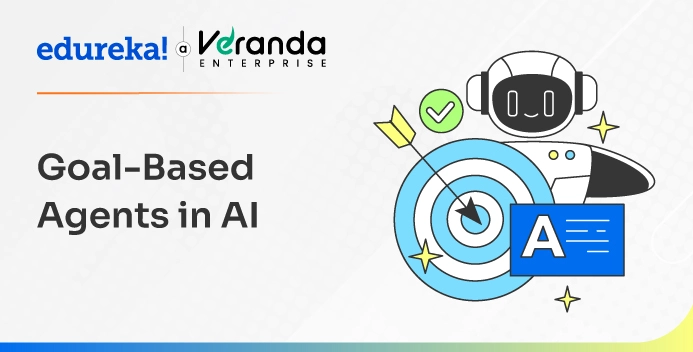
A goal-based agent in AI is designed to achieve specific objectives by analysing its environment and selecting the best possible actions.
In contrast to simple reflex agents, which react solely to the present conditions, the goal-based agents assess the various directions and means to get the preferred result.
A navigation app is a typical example from the real world. It not only reacts to changes in directions or paths, but also creates and modifies routes in real-time to your target location effectively.
Goal-based agents keep on observing the present condition and compare it with the desired condition or “goal.” Their movements are aimed at reducing the gap between the two states.
This is a step-by-step description of their functioning:
A goal-based agent in AI can have very important components listed as follows for efficient operation:
Goal-based agents are a significant part of many technologies used in real life. They facilitate the efficient planning, learning, and execution of operations in systems.
Some common examples include:
Goal-based agents provide several advantages but also have certain drawbacks.
Benefits:
Limitations:
To understand how goal-based agents stand out, let’s compare them with other types of AI agents:
| Agent Type | Decision Basis | Adaptability | Example Use |
|---|---|---|---|
| Simple Reflex Agent | Acts based on condition-action rules | Low | Automatic door sensors |
| Model-Based Agent | Uses internal models to decide | Medium | Smart thermostats |
| Goal-Based Agent | Chooses actions to reach goals | High | Self-driving cars |
| Utility-Based Agent | Maximises performance value | Very High | Investment bots |
Creating an AI-based goal agent can sometimes ease the burden of intricate coding during the initial stages. The concept consists of these three stages:
For beginners, simulation tools like Python’s AI Gym or OpenAI environments can help visualise how goal-based agents function in controlled setups.
The applicability of goal-based agents in various industries can be attributed to their adaptability and problem-solving ability.
The works of different disciplines together demonstrate the significance of such solutions in the intelligent automation of modern-day systems.
A goal-based agent in AI is a system that intelligently carries out specific tasks assigned to it by means of reasoning, evaluation, and adaptive decision-making.
It is a link between basic reactive systems and sophisticated utility-oriented AI models.
Through the understanding of the working principles of such agents, developers and learners can obtain a deeper insight into the decision-making process of intelligent systems, which is a fundamental concept in modern AI technologies.
Advance your career in AI with an Agentic AI course with certificate, focused on building and deploying autonomous AI solutions.
What is the main distinction between a goal-based agent and a reflex agent?
A reflex agent acts instantaneously as per the changing circumstances; conversely, a goal-based agent sequentially does actions until it achieves its objectives.
Where are goal-based agents applicable to applications of AI?
They are the minds behind navigation applications, chatbots, and autonomous robots that are strategically going about to accomplish their duties.
Can I build a goal-based agent without coding?
Yes. With the help of visual simulation platforms, one can create and evaluate conceptual models without any programming.
Which algorithms are commonly used by goal-based agents?
The most frequently used ones are A* search, Breadth-First Search (BFS), and Depth-First Search (DFS).
What is the effect of goal-based agents in increasing the efficiency of decision-making?
They do this by analysing multiple paths of action at once and selecting the most efficient path, hence conserving time and resources.











 REGISTER FOR FREE WEBINAR
  Thank you for registering Join Edureka Meetup community for 100+ Free Webinars each month JOIN MEETUP GROUP