Agentic AI Certification Training Course
- 135k Enrolled Learners
- Weekend/Weekday
- Live Class
(63442)


 Copy Link!
Gone are the days of rigid, menu-driven chatbots that struggled to process even basic queries. Modern conversational AI agents have redefined digital interaction, powered by advanced natural language processing (NLP) that allows them to understand context, interpret intent, and respond with near-human fluency.
This evolution marks a major milestone in customer communication. As highlighted in McKinsey’s 2023 report, “The Next Frontier of Customer Engagement: AI-Enabled Customer Service”, businesses are rapidly adopting conversational AI to drive efficiency, enhance customer satisfaction, and unlock new levels of engagement.
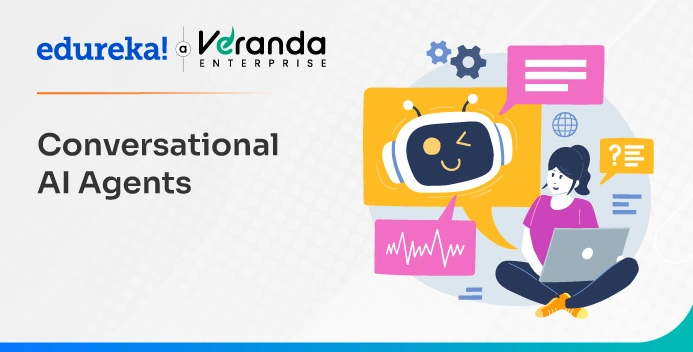
A conversational AI agent is an advanced software system that uses artificial intelligence to engage in human-like dialogue. Unlike traditional chatbots that rely on keyword matching and predefined responses, these agents leverage machine learning, natural language understanding (NLU), and natural language generation (NLG) to comprehend user intent and generate contextually appropriate responses.
Conversational AI agents can:
For a detailed comparison of modern conversational models, explore Edureka’s guide on ChatGPT vs Google Bard.
Natural language processing transforms basic chatbots into sophisticated conversational AI agents. NLP chatbots operate through several key processes:
Today’s conversational AI agents come equipped with capabilities that would have seemed like science fiction just a few years ago:
Advanced agents can seamlessly switch between languages or conduct entire conversations in multiple languages, breaking down communication barriers for global businesses.
By analyzing user data and interaction history, conversational AI agents deliver personalized experiences that feel tailored to individual preferences while serving thousands of users simultaneously.
Rather than waiting passively for questions, smart agents can initiate conversations, offer timely suggestions, and anticipate user needs based on behavior patterns and context.
These agents connect seamlessly with backend systems, CRM platforms, databases, and APIs, enabling them to access real-time information and execute complex tasks like booking appointments or processing orders.
Whether users prefer typing or speaking, modern conversational AI agents handle both modalities with equal proficiency, even understanding voice nuances like tone and emotion.
The versatility of conversational AI agents has led to their adoption across virtually every sector:
AI agents guide customers through product discovery, answer detailed questions about specifications, provide personalized recommendations, and streamline the checkout process. They handle post-purchase support, track orders, and manage returns—all while delivering 24/7 availability.
In healthcare settings, conversational AI agents schedule appointments, provide symptom checking, answer medication questions, and offer mental health support. They can triage patient concerns, send medication reminders, and handle routine administrative tasks that free up healthcare professionals for critical work.
Financial institutions deploy AI agents for account inquiries, transaction history, fraud detection alerts, loan applications, and financial advice. These agents can explain complex financial products, help with budgeting, and even detect unusual account activity.
Travel industry chatbots handle bookings, provide destination information, manage itinerary changes, and offer real-time updates about delays or cancellations. They can suggest restaurants, attractions, and activities based on traveler preferences.
Educational institutions leverage AI agents for student support, course recommendations, assignment help, and administrative queries. They can provide tutoring assistance, track progress, and adapt learning materials to individual needs.
The implementation of NLP-powered conversational AI agents delivers compelling advantages for both organizations and end-users:
The trajectory of conversational AI agents points toward even more sophisticated and seamless interactions:
Conversational AI agents powered by NLP are transforming how businesses connect with customers and how users access information. These systems now deliver intelligent, context-aware, and personalised interactions. As NLP evolves, the boundary between human and AI communication continues to blur.
Success lies not in imitating humans but in using AI’s strengths, speed, accuracy, and 24/7 availability, while complementing human expertise. The future of conversational AI goes beyond chatbots, redefining how technology truly understands and serves human needs.
How does a conversational AI agent differ from a traditional chatbot?
Traditional chatbots follow preset scripts and keyword rules. Conversational AI agents use NLP and machine learning to understand intent, handle context, and deliver adaptive, natural responses.
Can NLP help chatbots understand emotions?
Yes, sentiment analysis helps detect emotions like frustration or satisfaction using word choice, tone, and context, allowing chatbots to adjust responses or escalate when needed.
What industries are using AI chatbots the most?
E-commerce, banking, healthcare, telecom, travel, and insurance use chatbots for support, recommendations, and automation, improving efficiency and customer engagement.
How does machine learning improve chatbot performance?
Machine learning lets chatbots learn from each interaction, improving intent recognition, accuracy, and response quality without manual updates.
What skills are needed to build conversational AI systems?
Key skills include Python programming, NLP, ML, cloud platforms, conversation design, and UX understanding, often combining engineers, data scientists, and designers.







 REGISTER FOR FREE WEBINAR
  Thank you for registering Join Edureka Meetup community for 100+ Free Webinars each month JOIN MEETUP GROUP