As more workloads move to the cloud, we need fast, cheap, and reliable networks. AWS Direct Connect gives a dedicated network connection from your data center to AWS. This article will cover its traits, abilities, benefits, features, and uses.
What is AWS Direct Connect?
AWS Direct Connect is a cloud service that creates a direct network link between your data centers, customer networks, and AWS. Unlike the main method of accessing AWS via the Internet, Direct Connect offers a better path to AWS. It has less latency, more bandwidth, and better security. Considering building expertise in this domain? Head to AWS Certification Training.
The diagram shows that the customer network is connected to AWS via private VIFs over 802.1q VLANs. These VLANs create a dedicated line from the customer routers and firewalls to AWS Direct Connect sites. Network traffic is routed only to the Amazon VPC. After the resources are in the VPC, devices like EC2 instances can be securely accessed through a subnet in different AZs. This setup is highly available. 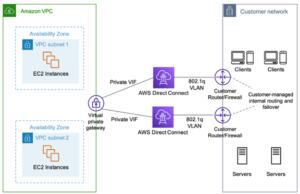
How Does it Work?
AWS Direct Connect lets you connect your offices and data centers to AWS via Direct Connect locations. Such connections are more reliable and faster than those using the Internet. The architecture above shows how data centers and branch offices connect to an AWS Direct Connect site, which connects to any AWS Region for resources.
Also, SiteLink logs Direct Connect communications between sites. It enables data transfer to other locations in your international network. This direct connection gives the business more control and speed. It also makes access to AWS more reliable. It boosts performance for high-bandwidth, low-latency tasks. 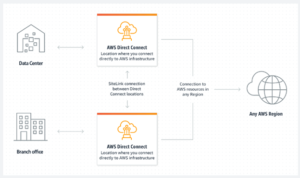
Components of AWS Direct Connect
- Connections: It is an Ethernet connection owned by you directly from your internal network to an AWS Region. This link can be private or programmable. It depends on the needed bandwidth, which ranges from 1Gbps to 10Gbps.
- Virtual Interfaces (VIFs): Public and private VIFs connect to AWS services. A public VIF provides access to public services, such as Amazon S3, while a private VIF allows one to connect to VPC.
- Direct Connect Gateway: It lets users connect VPCs in different regions using only a Direct Connect connection. It is more flexible and scalable for organizations that operate in different areas.
- Autonomous System Numbers (ASN): These numbers are employed to set up a totally defined external routing policy for Public and Private interfaces.
- Failover Setup: AWS Direct Connect supports BGP MultiPath and Active-Passive or Failover configs to improve availability.
Features of AWS Direct Connect
- Cost-effective: Sending data to AWS can cut bandwidth costs. So, “prospects” often mean both ingress and egress fees.
- Private Connectivity: Create a private connection with Amazon VPC to reduce the risk of social engineering threats from the internet.
- Elastic: Helps provide multiple bandwidths ranging from 1G to 10G to suit businesses’ needs.
- Simplified Setup: It is easy to use and deploy via the AWS Management Console; both have auto-scaling.
Use Cases for AWS Direct Connect
- Hybrid Networks: It can be easily integrated into organizations’ existing networks. This will speed up data transfers and improve AWS app performance.
- Data Transfer: It is the most useful in environments with large data sets. For example, media processing needs real-time data movement for broadcasting.
- Global Connectivity: SiteLink is a key part of AWS Direct Connect. It lets organizations transfer data between global locations via the best route.
Benefits of AWS Direct Connect
- Optimal Performance: AWS Direct Connect offers faster, low-latency links to AWS services. It is faster due to fewer network hops.
- Cost Reduction: It cuts data egress costs by up to 70%, making it a cost-effective solution for large data transfers.
- Enhanced Security: It ensures end-to-end communication. This avoids risks from internet threats.
- Reliability: Networked wireless can be 60% less unpredictable than the Internet.
Difference Between AWS Direct Connect & Site-to-Site VPN
| Feature | AWS Direct Connect | Site-to-Site VPN |
| Connection Type | Dedicated private connection | Public internet connection via a VPN tunnel |
| Latency | Low and consistent latency | Higher and variable latency due to public internet routing |
| Performance | High throughput, supports up to 100 Gbps | Lower throughput, typically up to 1.25 Gbps |
| Security | Private and secure; does not traverse the public internet | Secure through encryption but uses the public internet |
| Use Case | Ideal for high-performance, large data transfers or hybrid setups | Suitable for quick, cost-effective setups with moderate traffic |
| Cost | Higher, with port-hour and data transfer charges | Lower, with standard VPN usage costs |
| Reliability | More predictable and reliable | Less predictable due to reliance on the public internet |
| Setup Time | Requires more time and coordination to set up | Quick to set up through AWS Management Console |
| Bandwidth Options | Supports flexible bandwidth from 1 Gbps to 100 Gbps | Limited to lower bandwidth compared to Direct Connect |
AWS Direct Connect provides a private, high-speed connection. Site-to-site works over the Internet. Which solution is better for a business? Use a Site-to-Site VPN. It’s faster, cheaper, and more convenient than Direct Connect. Direct Connect is more secure and reliable and has low latency when connecting to Microsoft Azure services. If you are going for your next interview on AWS services, then this AWS Interview Questions guide would be very helpful to you.
Monitoring AWS Direct Connect
AWS Direct Connect resources can be set up and managed by tags, AWS CloudTrail, and CloudWatch. You can probably monitor metrics in CloudWatch and then audit every API call made in the cloud, which is logged in Cloudtrail.
AWS Direct Connect Pricing
It is basically done on the basis of port hour rates and data transfer charges. Port hours are determined by the connection type, which can be either dedicated or hosted, and the bandwidth. The charges for data transfer also differ, depending on whether the virtual interface is private or public; saving costs, especially when compared to the price of egress rates, is possible through Direct Connect.
Conclusion
Amazon Web Services Direct Connect is an effective tool for a business’s problem statement of improving Cloud Interconnectivity with efficient, secure, resilient, and cost-effective data transfer. Direct Connect is designed to provide for large data transfers, transitions to and from the hybrid cloud, and much more with a strong infrastructure available to meet your requirements.
FAQs
What is Direct Connect in AWS?
A private, dedicated connection from your on-premises network to AWS.
What is the difference between AWS Direct Connect and VPN?
Direct Connect offers a dedicated line, while VPN uses the public internet.
What is the difference between AWS Direct Connect and Private Link?
Direct Connect provides a physical connection, while PrivateLink secures access to AWS services without exposing them to the internet.
Is AWS Direct Connect Layer 2 or 3?
It operates on Layer 2 and 3, depending on the setup.
Is AWS Direct Connect secure?
Yes, it offers private and secure connectivity via the AWS global network.