Agentic AI Certification Training Course
- 136k Enrolled Learners
- Weekend/Weekday
- Live Class
(63442)


 Copy Link!
Artificial Intelligence (AI) continues to evolve beyond simple rule-based systems, giving rise to intelligent entities capable of acting independently. Among these innovations, autonomous agents in AI stand out as self-directed systems that can make decisions, learn from experience, and perform tasks with minimal human oversight. These agents are reshaping industries, from manufacturing to customer service, through automation and adaptive intelligence.
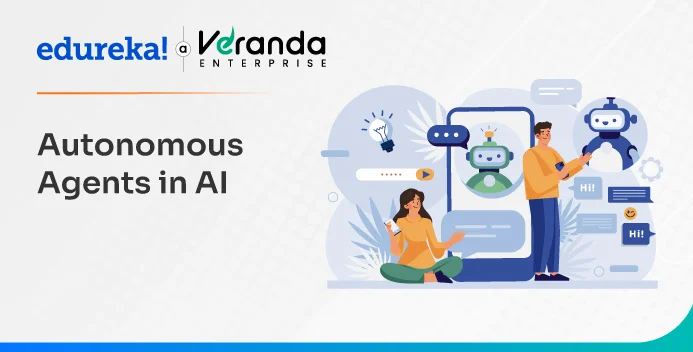
Autonomous agents in AI refer to smart systems that have the capability to work alone in a given setting and reach the targeted objectives. With the help of perception, decision-making, and action abilities, they are able to operate without human control.
They are simply “self-managing” AI applications that can learn, reason, and act according to the real-world data. Moreover, the systems can recognize the issues, formulate the solutions, and conduct the actions that are consistent with their goals.
Key characteristics include:
Autonomous AI systems are equipped with a unique set of features that enable them to make smart and efficient decisions. These features are the foundation of the systems’ capabilities, namely:
These systems integrate observations, learning and decision making
Autonomous agents in AI have been the primary factor in the automation of tasks that had previously required human participation. The AI automation agents can not only keep an eye on the systems but also instantly find and rectify the problems as well.
Here’s how they are driving automation across sectors:
The operation of autonomous AI systems is composed of a series of steps that are connected among each other and that allow the machines to function intelligently:
This continuous loop is what makes it possible for the learning AI agents to evolve, adapt, and improve without any help.
The use of autonomous AI applications is gradually taking over the industries. Their reliability and self-learning features are the main reasons for this shift.
There are several instances that are worth mentioning and these are:
Even though they are promising, the creation of reliable AI automation agents is accompanied by great difficulties.
The main challenges are:
The future of self-learning AI agents powered by the integration of machine learning, reinforcement learning, and neural networks is definitely very bright. With these technologies, the agents are able to make themselves better using only internal transformations without any reprogramming from the outside.
Emerging trends include:
As technology evolves, autonomous AI systems will move from narrow automation to strategic, decision-driven intelligence.
Implementing autonomous AI solutions is a phased process. Success depends on preparing the right technology and cultivating the right mindset.
The process of adoption has the following steps:
If the proper strategy is in place, autonomous AI will take the level of operations up to intelligent and adaptive ecosystems.
The utilization of autonomous agents in AI within artificial intelligence denotes an essential change towards smart workflows. These agents operate as advanced digital assistants capable of independent reasoning and action. Organizations that integrate them are better positioned to achieve higher accuracy, streamlined workflows, and stronger competitiveness in a data-focused world.
The journey towards total autonomy for AI systems has just begun, but the amount of their effect on the changeover of some industries has already been recognized to a great extent.
What does it mean to have an AI agent that is autonomous?
An autonomous AI agent can be defined as an agent that is able to make and execute decisions without any human involvement, based on the use of data-based intelligence to evolve and change constantly.
How do self-directed agents promote automation?
They substitute repetitive or analytical activities like all the time checking on the systems, responding to the questions of the people, or making on-the-spot optimization of the operations.
What are some of the autonomous intelligent systems?
Autonomous cars, virtual assistants, industrial robots, and AI-powered stock trading algorithms are some of them.
Are autonomous AI agents safe for large-scale use?
Yes, if they are well-designed. Safety of the system will be improved with the help of transparency, explainable AI and strict ethical supervision as well.
How do self-learning AI agents improve over time?
The agents improve their performance by taking into account the results of the analysis, finding patterns and continuously learning, i.e., by updating their models.










 REGISTER FOR FREE WEBINAR
  Thank you for registering Join Edureka Meetup community for 100+ Free Webinars each month JOIN MEETUP GROUP