Agentic AI Certification Training Course
- 133k Enrolled Learners
- Weekend/Weekday
- Live Class
(63442)


 Copy Link!
In an era where healthcare demands are rapidly increasing and resources remain constrained, the introduction of advanced technologies has become non-negotiable. Agentic AI has become one of the most significant innovations, which enables all machines to make independent decisions and perform tasks without human direction.
The global agentic AI in healthcare market is expected to reach $4.96 billion by 2030, growing at 45.56% from 2025 to 2030, exhibiting its rapid adoption and potential. Innovation is not only about smarter software, it is also all about new forms of providing care to patients, enhancing outcomes, and lowering expenses. Recent data show that agentic AI can support all clinicians in diagnosing more accurately, personalizing treatments faster, and optimizing operations more effectively.
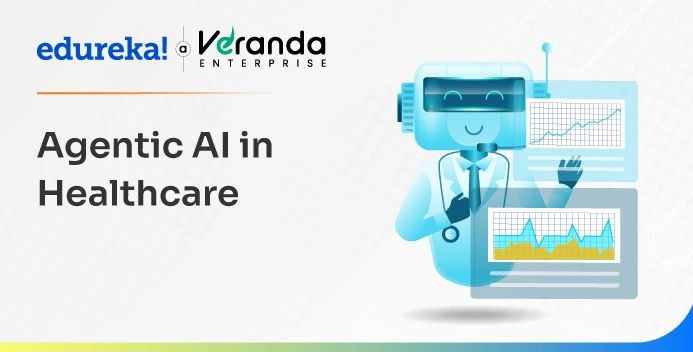 This guide explores into agentic AI healthcare, including why it is expanding in the field, its primary applications, how it differs from traditional AI, its impact on patient care, and its future.
In healthcare, Agentic AI refers to a new generation of AI models capable of more than just interpreting data. They can autonomously execute actions, design and adjust workflows, make coordinated decisions, and adapt to evolving clinical or operational scenarios.
In a hospital environment, an agentic AI might independently monitor patient vitals, recognize potential health issues, set up future assessments, send alerts to caregivers, and update treatment protocols, all without manual direction.
Its power lies in three fundamental aspects: autonomy, allowing self-governance; reasoning, enabling thoughtful planning; and interaction, ensuring effective communication between technology, people, and surrounding systems.
There are several strong reasons why agentic AI is rapidly becoming a focus in healthcare:
Below are the main application areas and the ways Agentic AI enhances each of them:
Real-time analytics of multi-modal data: These systems correlate lab results, genomics, vitals, and imaging to flag disease earlier.
Reduced diagnostic errors: Agentic AI improves accuracy by standardizing operations and detecting trends people overlook.
Precision medicine enabled: The agentic AI uses genetics, history, lifestyle, and real-time responses to tailor treatments.
Dynamic adaptation: AI adjusts treatment strategies based on patient responses.
Engagement and adherence: VR assistants provide patient advice, refill medicines, and personalize wellness plans.
Resource forecasting: They predict demand for ICU beds, ventilators, staff shifts, and supplies.
Administrative relief: Data entry, authorizations, and claims processing can be autonomously handled.
Preventive interventions: They provide preventive suggestions, schedule screenings, and notify clinicians based on pattern analysis.
Drug discovery acceleration::Agentic AI screens molecular libraries, simulates interactions, and prioritizes candidates for trials.
Clinical trial optimization: It identifies appropriate patients, designs protocols, and adapts trials in real time.
| Key Differentiator | Traditional AI in Healthcare | Agentic AI in Healthcare |
| Autonomy | Only reacts in response to a human input. | Acts autonomously, initiates processes, and completes tasks without waiting for instructions. |
| Multistage Decision Making | Takes in data and provides single-step or static outputs. | Plans, acts, and adapts across multiple steps-from data gathering through reasoning to action. |
| Integration Across Systems | Often depends on just one tool or system. | It works with EHRs, wearable tech, and operational tools to let people work together and automate workflow. |
| Continuous Learning and Adaptation | Remain static after first training, requiring retraining for upgrades. | Constantly learns and changes based on patient engagement and real-world data. |
| Built to Operate Under Guardrails | Limited focus on regulatory alignment or safety protocols. | Designed to work within strict clinical protocols, safety standards, and regulations, thus engendering trust and reliability. |
Agentic AI improves patient care in several tangible ways:
Here are eight concrete use cases demonstrating real-world impact:
Looking towards the future, the prospects of using Agentic AI in healthcare appear bright:
Agentic AI in healthcare marks a critical transition from assistive to autonomous care, with intelligent agents computing, acting, coordinating, and optimizing care at all stages of the patient’s journey. The benefits are numerous, ranging from better diagnostic precision and personalized therapies to streamlined operations and proactive health management.
Ahead of us lies the journey that will make healthcare smarter, quicker, and more personalized to achieve better patient outcomes. Now is the time to embrace Agentic AI and help shape this transformation, whether in healthcare or strategic decision-making.
Q1: Can Agentic AI help doctors make better medical decisions?
Yes, by analysing large volumes of patient data (imaging, vitals, genomics, history) and generating real-time actionable insights, agentic AI supports clinicians in identifying conditions earlier, recommending optimal treatments, and reducing errors.
Q2: How does Agentic AI ensure patient data privacy and security?
Numerous frameworks of agentic AI in healthcare incorporate regulatory compliance tools (e.g., attribute-based access control, audit trails) to guarantee the privacy of patient data. Researchers need context-aware policy enforcement, sanitisation of PHI, and secure architectures.
Q3: Is Agentic AI replacing human roles in healthcare or supporting them?
The concept of agentic AI is created not to substitute but to assist human professionals. Although it automates the workflows and helps in the decision-making process, human control, clinical judgment, empathy, and responsibility are crucial. Human-AI collaboration leads to the greatest results.
Q4: What are some real-world examples of Agentic AI being used in hospitals?
Home-monitoring agents switch treatment plans, autonomous agents in imaging-analysis give priority to urgent scans, virtual assistants give advice to patients, and hospital systems are automated to perform scheduling and claim collections.
Q5: How affordable and accessible is Agentic AI technology for healthcare providers?
Old systems were costly and isolated, whereas Agetic AI, along with open-source agentic frameworks and scalability, make costs less expensive. Accessibility is also increasing with acceptability and competition among vendors, which can be accompanied by deployment and integration problems with resource-constrained systems.








 REGISTER FOR FREE WEBINAR
  Thank you for registering Join Edureka Meetup community for 100+ Free Webinars each month JOIN MEETUP GROUP